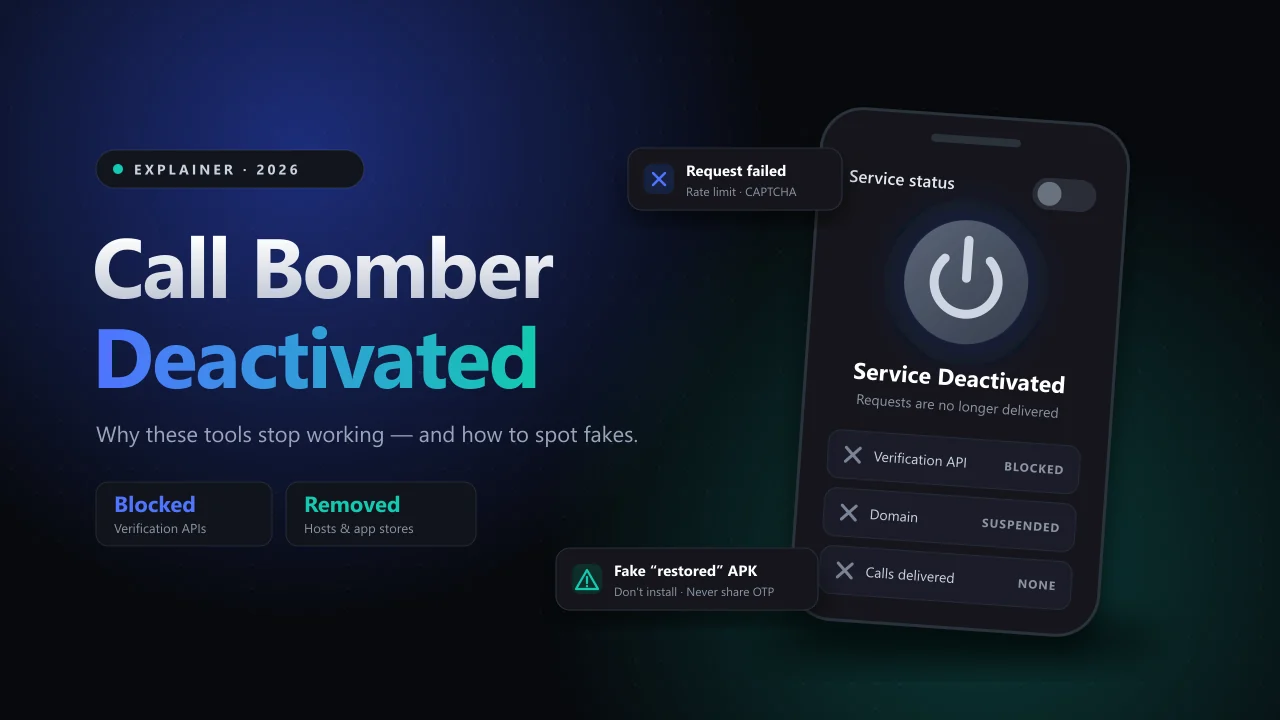
Call bomber deactivated usually means a call-bombing website, app or account has stopped working, most often because the phone verification services behind it blocked the abuse or the host removed the tool. It is rarely a temporary glitch, and it is never a reason to download a “restored” version. This guide explains what deactivation means, why it happens, and how to tell a real shutdown from a fake revival claim.
What Does “Call Bomber Deactivated” Mean?
A call bomber is a tool that triggers many calls to one phone number in a short time, usually by abusing the verification calls websites send during sign-up. It is different from a consent-based prank app such as the Call Bomber APK. When people search for call bomber deactivated, they are describing one of three situations:
- The tool is gone: the website, app or Telegram bot no longer exists.
- The tool runs but does nothing: it loads and accepts a number, yet no calls arrive. This is the typical “call bomber not working” complaint, and the same pattern is explained for the BOMBitUP APK.
- Access is blocked: the tool still exists, but your account, IP address or number has been restricted.
These cases look alike from the outside, but their causes differ, and none of them guarantees that the tool will come back.
Why Call Bomber Tools Stop Working
Call bombers do not place calls themselves. They borrow them from other companies’ verification systems through third-party APIs, so a tool is only as stable as its weakest borrowed connection. When that connection is cut, the tool looks deactivated.
| Cause | What happens behind the scenes | What you notice |
|---|---|---|
| Provider blocks | Companies whose verification calls were abused add rate limits, CAPTCHAs or number checks, so each request fails | The tool says “sent” but no call arrives |
| Overuse | Heavily used connections get flagged and shut down quickly | It worked yesterday and fails today |
| Takedowns | Hosts, domain registrars and app stores remove services that enable harassment | Error page, suspended domain or a vanished app |
| Carrier filtering | Mobile networks detect bursts of short, repeated calls and filter them | Calls drop or never ring |
Because borrowed connections keep getting closed, a tool that works briefly and then dies is the normal pattern, not the exception.
Deactivated, Down or Blocked: What Is the Difference?
These three terms are often mixed up, but each points to a different situation with a different outcome.
| Status | What it means | Is it permanent? |
|---|---|---|
| Deactivated | The operator, host or verification providers shut the service off, or its borrowed connections were closed | Usually yes, for that site |
| Down | A temporary fault such as server overload, maintenance or a DNS problem | No, it often clears within hours or days |
| Blocked | Your access, IP address or number is restricted while the service stays online for others | Depends on the operator |
If a site stays unreachable for more than a week, or its domain shows a suspension or parking page, treat it as deactivated rather than down.
Is It Really Deactivated? How to Tell
Not every outage is permanent. Run these checks before drawing a conclusion:
- Look at the pattern. If a site loads but delivers no calls for several days, the connections behind it are almost certainly closed.
- Check the domain. An expired domain or a hosting suspension page points to a takedown.
- Watch for copies. Clone sites with near-identical names appear whenever a popular tool disappears. A new domain is not a revival; it is usually a different operator.
Is Call Bombing Legal?
In most countries, deliberately flooding someone with calls counts as harassment. Depending on the country, it can fall under cyber stalking, telecom misuse or harassment laws, for example the Prevention of Electronic Crimes Act (PECA) 2016 in Pakistan or the Information Technology Act in India. Telecom operators keep call records, and authorities can request them during an investigation, so this activity is often traceable. If a number keeps bothering you, see how to block spam calls on Android and iPhone. This is general information, not legal advice. For a specific situation, speak to a qualified lawyer.
Final Thoughts
Call bomber deactivated almost always points to blocked verification connections or a takedown, not a temporary bug. Treat any page that claims to have revived a deactivated tool with suspicion, and rely on official announcements rather than third-party claims.